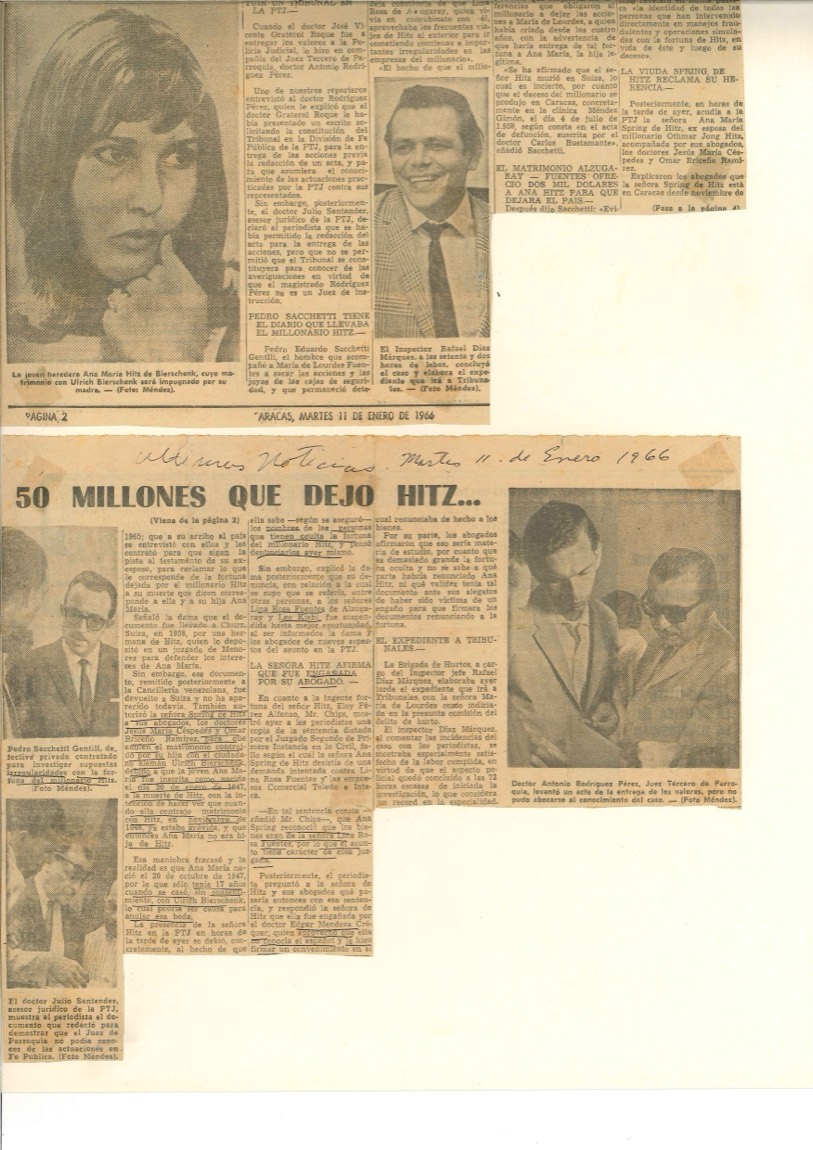
In January 1966, a Venezuelan press photographer named Mora photographed my grandmother outside the Judicial Technical Police headquarters in Caracas. She was nineteen, in a tailored shift dress and dark glasses, her infant daughter, my mother, in her arms; my grandfather stood beside her in a pressed suit. They had come to file a claim for thirty million bolivars, roughly ten million dollars, the estate she believed she had inherited from her father. They looked like film stars. They could not pay their own hospital bill.
A beggar stopped to ask what the crowd was about. Told that the young woman was about to inherit a fortune, he said the line the paper printed under the picture: “And to think that I only have one coin.”
The Millionaires and the Beggar. THEY: 30 million. HE: One coin.
The photograph that made the fortune look real
It took the family sixty years to understand the real joke in that caption. The beggar and the heiress were in the same position. Each had exactly what was in their hands. The difference, as the family says now, is that the beggar knew it.
The jewels: worth 70,000, pawned for 16,000
The same January, the investigation made the abstraction concrete. Jewels and securities that Othmar Hitz had left to his daughter, stored in safe-deposit boxes at two Caracas banks, had been removed and pawned at a Caracas pawnshop for sixteen thousand bolivars. Their reported value was seventy thousand. La Verdad's headline on January 8, 1966 drew the legal distinction that would haunt the case: the jewelry “was not stolen but seized.” Whoever took it claimed the authority to take it.
The jewels were eventually redeemed, with money supplied from inside the same circle that had let them go, and a police inspector standing witness at the pawnshop counter. The estate paid its own ransom, to itself, in front of the law. That one transaction is the Hitz inheritance in miniature: real assets, real value, moving in plain sight between people with claims, while the person they were left to held a baby outside the police station and went home with nothing.
The fortune existed mostly in headlines, and the headlines kept changing the number: ten million dollars in Washington, thirty to fifty million bolivars in Caracas, up to 150 million francs in the Swiss papers. The spread was never proof the fortune was imaginary. It was proof of how well it had been hidden.