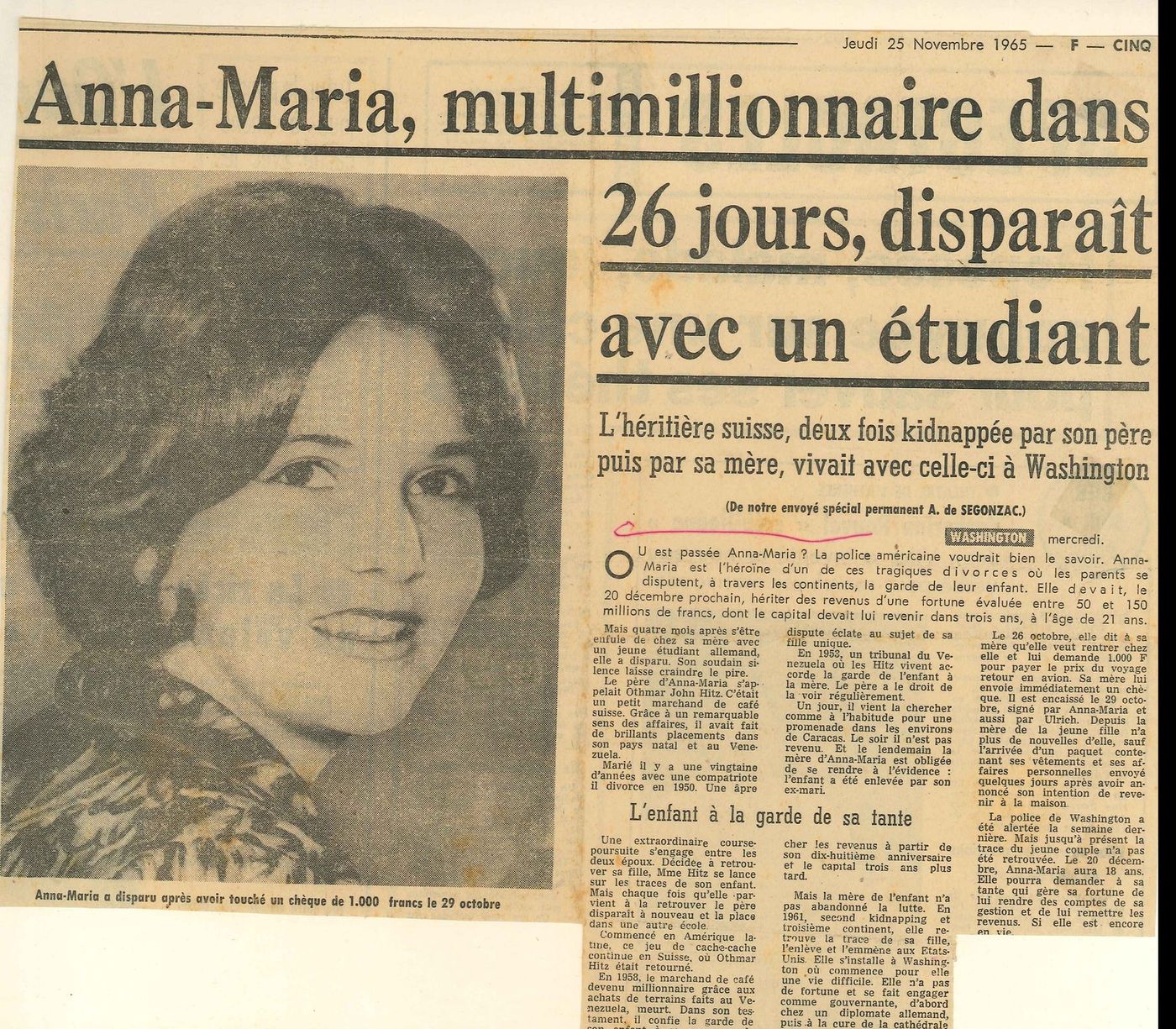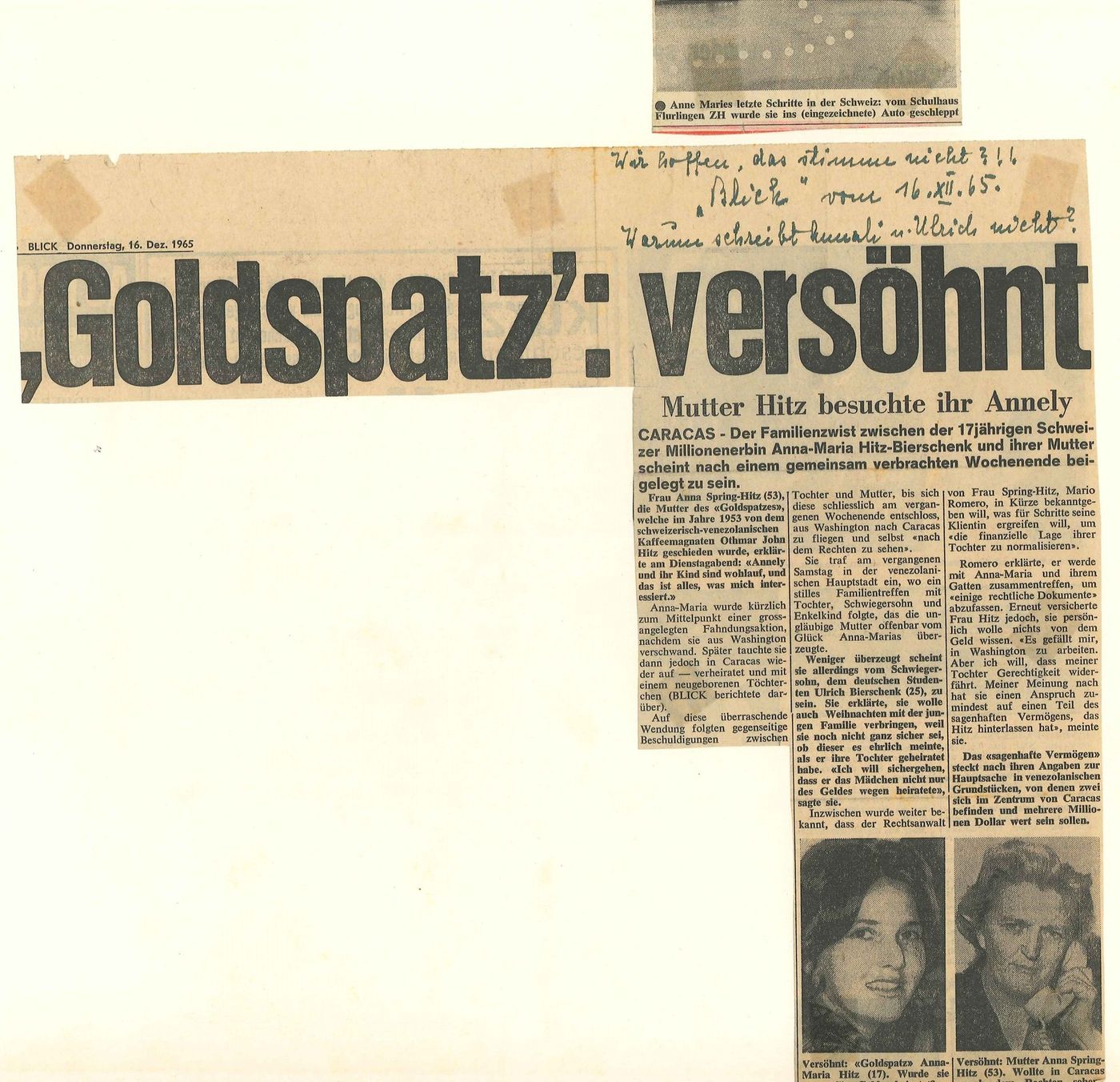
The Goldspatz, the golden sparrow, was the name the Swiss press gave Anna Maria Hitz: a child heiress too valuable to be left alone and too precious to be set free. The Caracas papers had their own version, pájaro enjaulado, the caged bird. Both names described the same fact. From the age of five, she was an asset that people fought over, and the fighting was done in courtrooms, boarding schools, and eventually on the front pages of Europe.
The cage was built early. Per the family's account and the court records, her father took her to a park in Caracas when she was about five years old and did not bring her back; her mother would not live with her again for nearly a decade. The girl was sent to Swiss boarding schools, placed under guardianship, and, in the words of the translated Swiss press, “disconnected” from every ruling that favored her mother. Visits were supervised, scheduled, and sometimes simply denied.
There is a child's letter in the archive, dated December 20, 1959, her twelfth birthday, written after one of those denied visits. “Dear Mamma. We waited for you in the Lukmanier until almost four o'clock today. I was looking forward to the birthday. I'm sending you the package here. I did everything myself for you.” The European press published it as proof that the love between mother and child had survived the system built to manage them.
January 6, 1961: twenty minutes to the border
Then the mother stopped petitioning. On the morning of January 6, 1961, two of her relatives waited outside the village school in Flurlingen in a rented car, plate TG 4180. When thirteen-year-old Anna Maria came out for the break, they pulled her in and drove. Interpol was alerted within twenty-four hours. The Swiss papers called it a kidnapping.
The detail that undid the headline came from the investigation itself: there were, as the press put it, no gangsters in the car. The men were her cousins. An understanding between daughter and mother, the report said, “was able to be quickly materialized,” and the Swiss border was crossed in a completely normal way after just twenty minutes.
Twenty minutes is how long the girl needed to choose her mother. The charges were reduced, the mother was never prosecuted, and the press, which had arrived for a crime, stayed for the injustice. That is when the nickname stuck: the golden caged bird, kidnapped from her cage by the person who loved her most.
Mother and daughter ended up in Washington, D.C., a housekeeper's wages and a private school scholarship between them and the fortune waiting in Caracas. Four years later, at seventeen, the Goldspatz vanished again. That time, she did it herself.