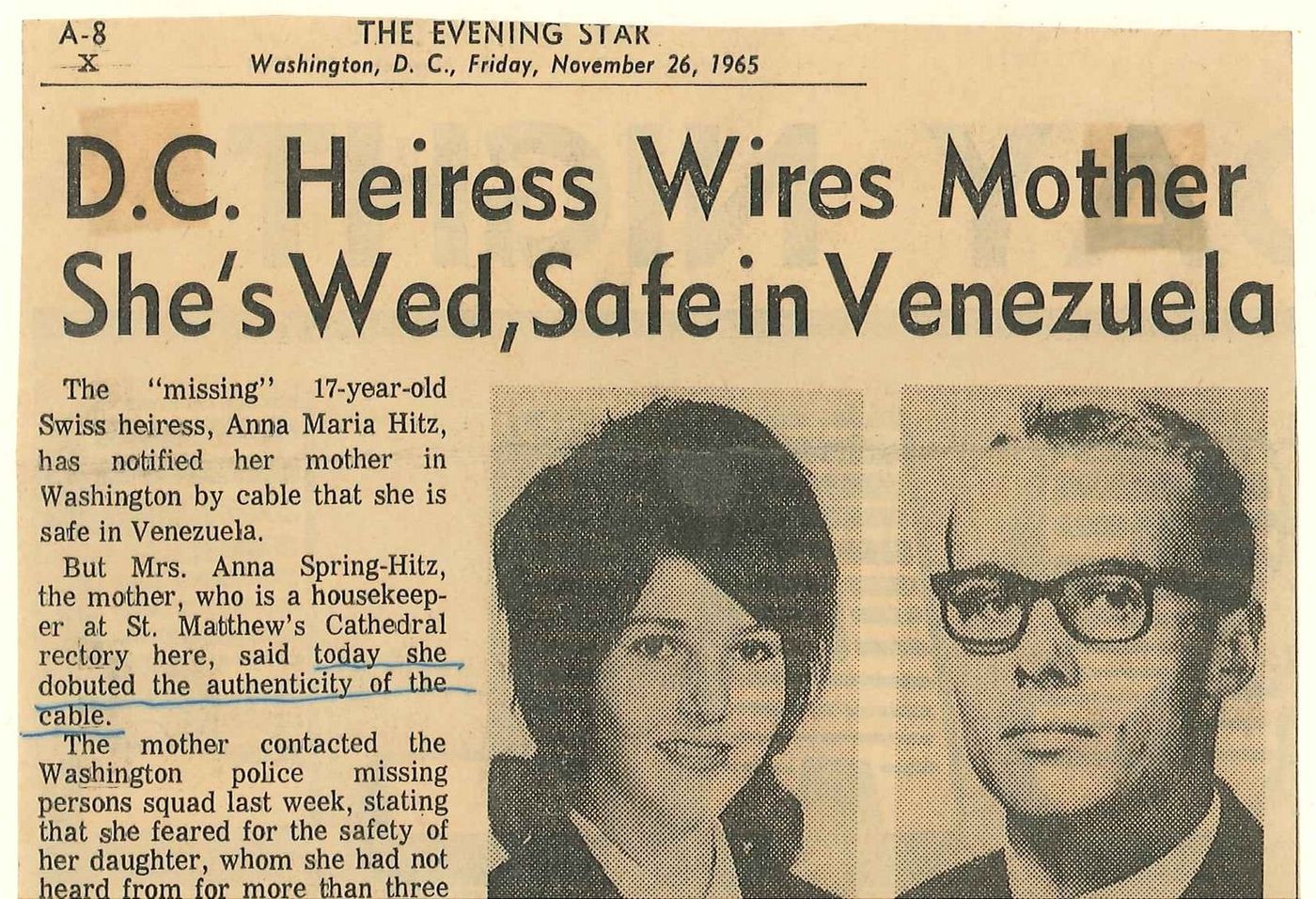
On November 26, 1965, three days after The Washington Post put the missing heiress on its front page, a cable arrived from Caracas and ended the search. The papers printed it in full. Sixty years later, it is still the most quoted document in the Hitz archive.
Have married. Birth certificate shows I am 18. Letter follows. Stop this ridiculous persecution. I am happy now.
Signed “Annely,” by cable to her mother
Annely was the family nickname, the same one she had signed on a Christmas letter to her mother six years earlier, as a child in Switzerland. The papers noticed. It read like proof of identity, and proof of something else: that the seventeen-year-old the world was hunting did not consider herself lost.
Her mother was not convinced. The Evening Star reported the same day that she doubted the cable's authenticity; she told reporters it “did not sound as if it were written by her daughter.” She had spent a decade fighting courts on two continents for this girl. She knew what documents could be made to say.
What the cable did not say
It was real. And the truth behind it was stranger than the mystery. Anna Maria had landed in Caracas on November 2, 1965, nine months pregnant, and was rushed from the airport to the Centro Médico maternity hospital, where she gave birth to a daughter that same day. When the front page ran in Washington, the “missing” heiress had already been a mother for three weeks.
The husband was Ulrich Bierschenk, a twenty-three-year-old German student she had met at the German Embassy in Washington, where he worked the summer as, depending on which paper you read, a janitor, a security guard, or, in BLICK's version, the Nacht-Wächter: the night watchman. They had crossed America with a Chow dog while, per the family's account, accusations chased them from job to job. When a family servant in Caracas was finally reached by telephone, he reassured the world's press in one line: “The husband, the wife and the baby are O.K., even the dog is O.K.”
One more detail, buried in the wire copy, kept the family reading for sixty years. The couple was reported “in guarded seclusion at the mansion of a wealthy Venezuelan widow.” Who that widow was, and what she had to do with the fortune Anna Maria had come to claim, is where the love story stops and the other story begins.