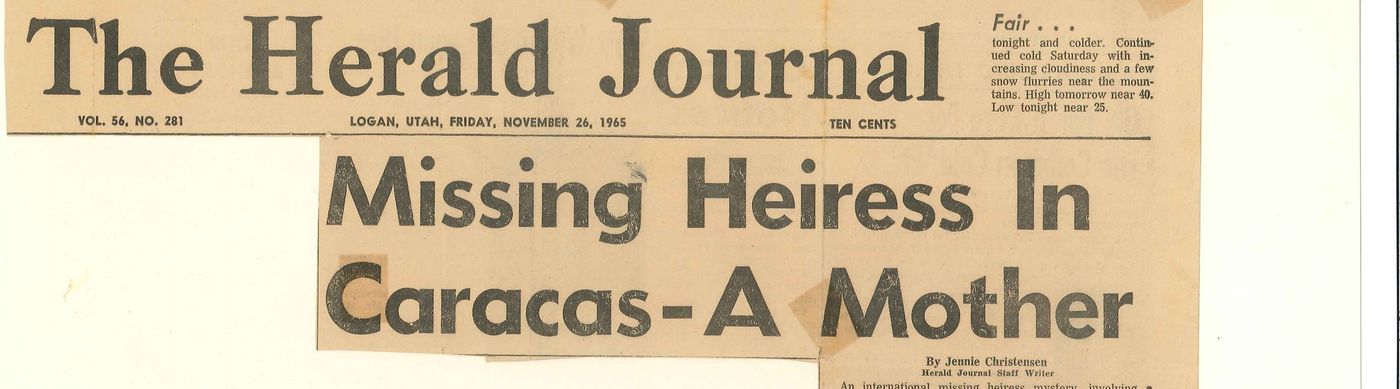
The disappearance of Anna Maria Hitz was the first viral story my family lived through, decades before the word existed. It started on the front page of The Washington Post on Tuesday, November 23, 1965. By Friday the same story, with the same photographs, was running in Logan, Utah and Philadelphia. Within weeks it was in Zurich, Hamburg, Paris and Caracas, in at least four languages. The wire services were the algorithm. The front pages were the feed.
You can watch it spread through the archive. The Post breaks it. The Evening Star follows with the cable. The Herald Journal in Logan, Utah, where the husband had been a student, runs “Missing Heiress in Caracas, A Mother” with local pride and local detail. The Philadelphia Evening Bulletin picks up the UPI dispatch: “Girl, 17, in Caracas Says She Is Missing Heiress.” The Associated Press finds a family friend in Caracas; a servant reassures the world that “even the dog is O.K.”
And then each country made it its own story. Paris made it a romance: the heiress, multimillionaire in twenty-six days, runs away with a student. Germany's BILD ran the husband's version, true love. Zurich made it a banking story and gave her the name that stuck, the Goldspatz. Caracas made it what it always was underneath: a corruption story, the fifty million that Hitz left, and the question of who was holding it.
The reporter who came back
Here is the detail the family kept for sixty years. After the headlines faded, a Washington Post journalist returned to the family and asked to turn the story into a book. Per the family records, both of the reporters who would later break Watergate pursued the story. The family, young and wary of the press that had consumed them, said no. The book he asked to write never happened.
This one did. Written not by a reporter looking in but by the granddaughter who grew up inside it, from the archive the newspapers never saw: more than 500 documents, four languages, eight countries, court papers, letters, photographs, a diary. The papers had seventy-two hours with this story. The family had sixty years.
Twelve documents are public. Read them in order in the archive, watch the ninety-second teaser cut from the real scans, or start with the first dispatch.