Under the Swiss Bankers Association guidelines, a bank account becomes "without contact" after ten years in which the bank cannot reach the client, "dormant" after a further fifty years, and after sixty years in total the bank must publish it on the internet if the entitled person still cannot be found and the value exceeds 500 francs or is unknown. The publication runs for one year at dormantaccounts.ch. If nobody with a valid claim comes forward in that year, the assets are transferred to the Swiss Confederation and the customer's rights lapse.
Those are the rules as the banks themselves state them. They apply to accounts, safe-deposit boxes and custody holdings alike. For safe-deposit boxes, whose value is unknown, publication is required regardless of what is inside.
How a claim is made
Anyone who believes they are entitled to dormant Swiss assets can go two ways. The first is the published list itself: an entry at dormantaccounts.ch carries a form, and the claimant files online with proof of identity and proof of entitlement, which for heirs means a certificate of inheritance and the death and civil-status documents behind it. The second is the Swiss Banking Ombudsman, which runs the central search for assets that have not yet reached publication; the claimant submits documents that substantiate entitlement, and the Ombudsman queries the banks. Neither route needs a lawyer. Both are slow without one, because the certificate of inheritance is issued by a court and the chain of heirs must be proven document by document.
Why the mid-2020s matter for a 1963 wire report
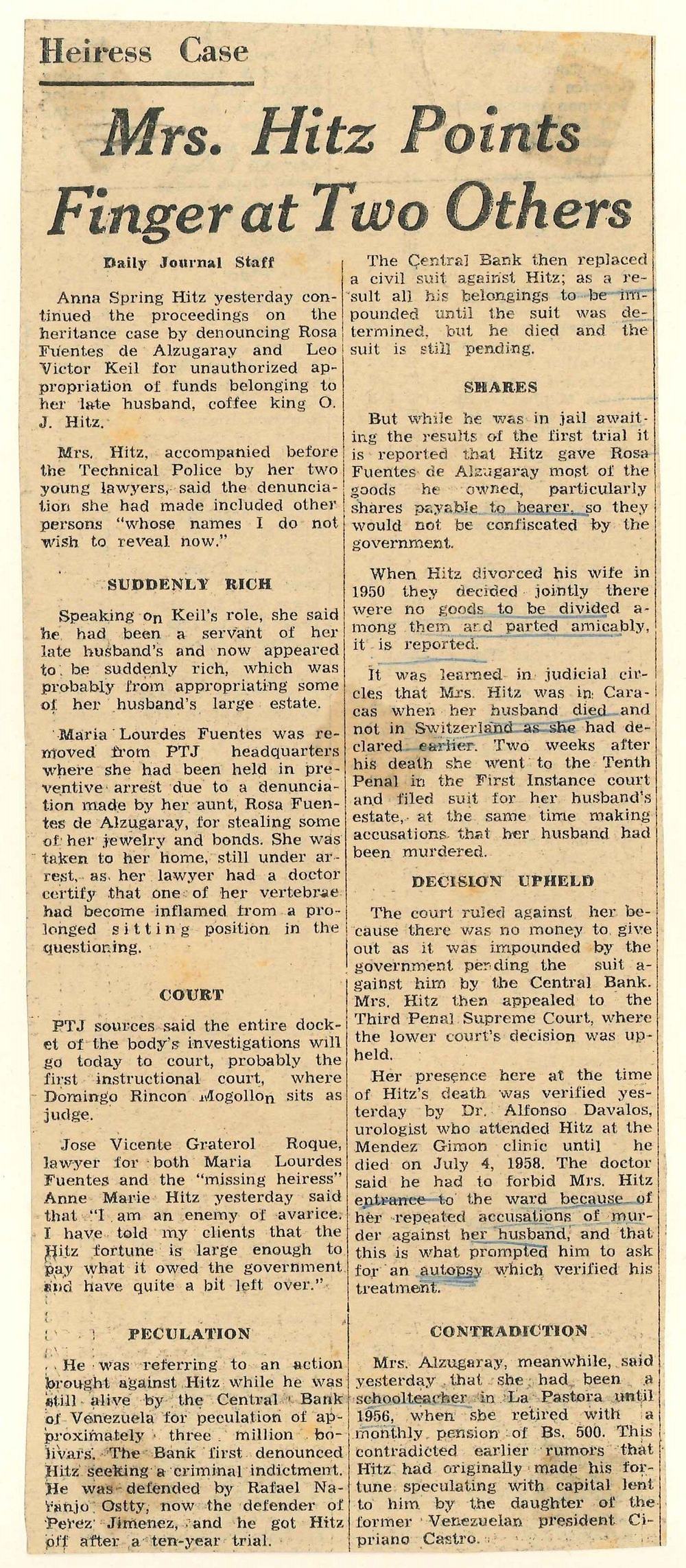
On the Hitz side the public record gives only this: in August 1963 UPI reported that the inheritance was frozen in a Swiss bank, and the family says nobody ever collected it. Nothing on this site says that an account exists today, where it is, or what it holds. What the rules do say is simple arithmetic: an account whose last client contact fell in the mid-1960s reaches the sixty-year mark in the mid-2020s. That is the whole reason the family has put its questions to counsel now rather than later, and why the page for counsel exists.
The family carries the dates that cut against it as openly as the ones that help. An account that was closed, transferred or emptied in the 1960s has no clock at all. Only a lawyer with the register in front of them can say which case this is.