File 06 · The Mechanism
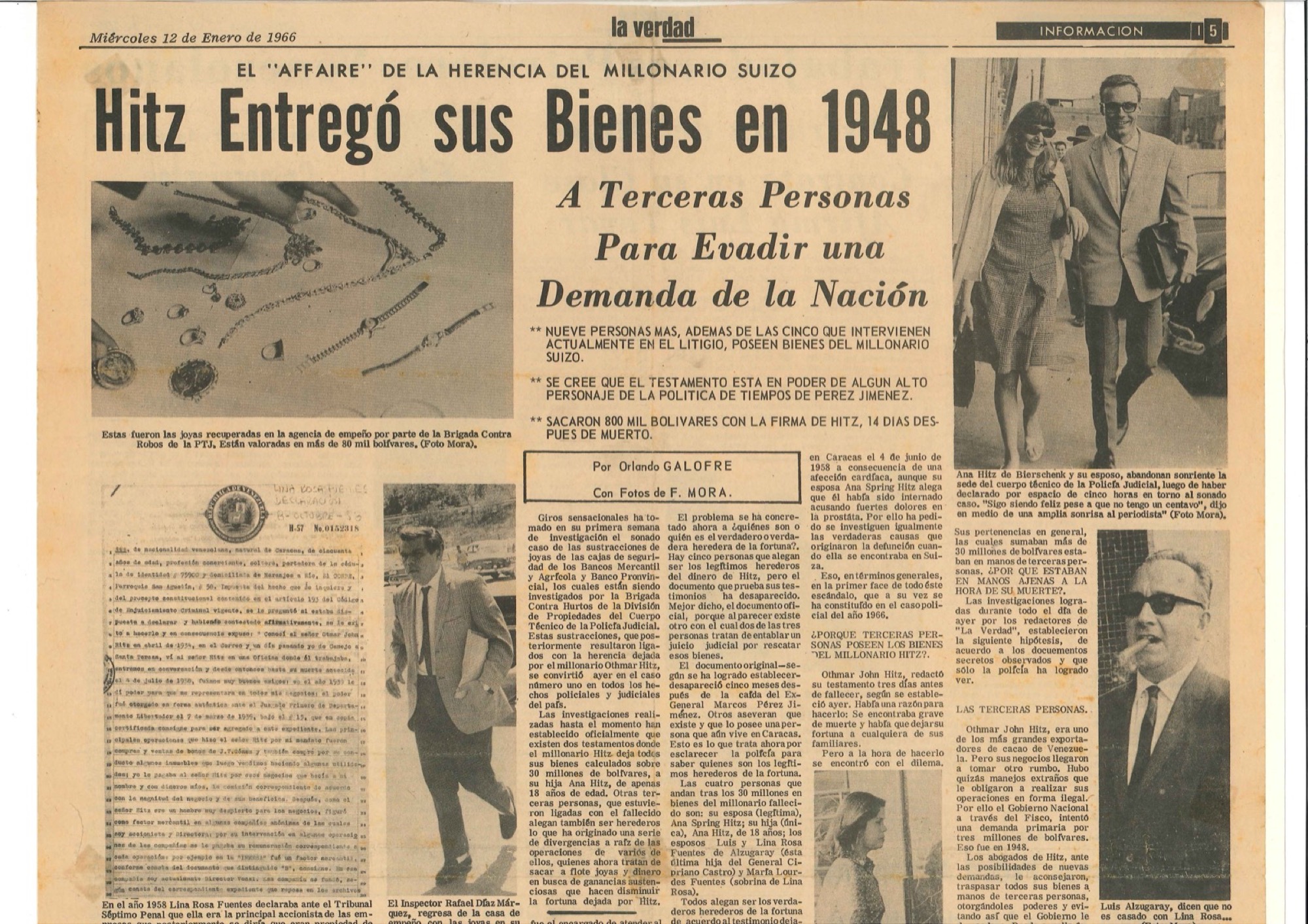
Three papers, one method
The question this site has always ended on is where a fortune of that size went. It turns out three Caracas newspapers answered it inside a single fortnight in January 1966, and the family never had the pages translated.
La Verdad ran it first, on 12 January 1966, under a headline that is the whole answer in one line: Hitz Entregó sus Bienes en 1948 A Terceras Personas Para Evadir una Demanda de la Nación. Hitz handed his assets to third parties in 1948 to evade a claim by the nation. The same page reported that nine more people, beyond the five then in the litigation, were holding assets of the Swiss millionaire, and that Bs 800,000 had been drawn on his signature fourteen days after he died.
Últimas Noticias followed on 13 January with the fuller version, under a section heading that could serve as the title of this page: Dónde se inició y cómo se ocultó la fortuna de Othmar Hitz. Where the fortune began, and how it was hidden.
According to that report, the money started in house sales built on a differential rate the Banco Central de Venezuela had set for coffee and cacao purchases between 1942 and 1947. Últimas Noticias of 13 January 1966 reported that the bank later judged those operations fraudulent, that most of the other merchants paid the bank back, and that Hitz refused and was charged with estafa.
The case ran for ten years and then lapsed. Últimas Noticias reported that he was warned he could still be sued for damages, and that he responded by putting his property in other people's names. When the bank returned with a civil claim, the paper wrote, the embargo the judge ordered could never be executed, because by then nothing stood in his name.
Ese testamento no fue hallado nunca.
Últimas Noticias · Caracas, 13 January 1966
Then the detail that decided the next sixty years. Últimas Noticias reported that months after moving his assets, Hitz fell ill, and that knowing he was dying he wrote a will specifying which people were holding which of his property, all of it left to his daughter Anna Maria.
That will was never found.
The same paper reported that on 31 July his former wife sued Leo Kiehl to hand over the will and the property she said he was concealing, and that the action and the appeal to the Corte Superior Tercera en lo Penal both failed, because it could never be proved that Kiehl held power of attorney or possessed the missing document.
The name it was hidden under
On 18 January 1966 El Nacional printed the part the other two had not: Hitz Tenía su Fortuna A Nombre de Lina Rosa Fuentes Para Evadir Pago a la Nación De 3 Millones de Bolívares.
The fortune, on Anna Spring's account to that paper, was held in Lina Rosa Fuentes's name, to avoid repaying three million bolívares the Banco Central said he had taken. El Nacional added that he had served a year in prison in 1947 over the matter.
Lina Rosa Fuentes was a daughter of General Cipriano Castro, the former president of Venezuela. In court in January 1966 she wanted nothing to do with any of it. “Que me devuelvan mis joyas y acciones, no quiero saber de herencia,” she told the tribunal. Give me back my jewels and my shares, I want nothing to do with an inheritance.
What this is, and is not
None of the above is a finding of any court. It is what three Caracas newspapers reported in January 1966, while the investigation was live and the people named were alive to contradict them.
And the papers did not agree with each other. On 18 January Últimas Noticias ran a piece headed ¿Es Producto Imaginativo la Herencia de Hitz?, asking whether a man with his assets already embargoed could have accumulated fifty millions in five years, and asking pointedly why Mrs Hitz had never taken the case against Leo Victor Kiehl to cassation. Rafael Naranjo Ostty told La Esfera the estate had never reached five million bolívares, and that a legend had been made of it. La Verdad noted that it had not been possible to demonstrate the fortune existed at all.
Both readings are in the record. This page carries both.
The case file ends here · The rest is sealed
The Sealed File: what the papers never printed, and the memoir's first chapter.
Continue →